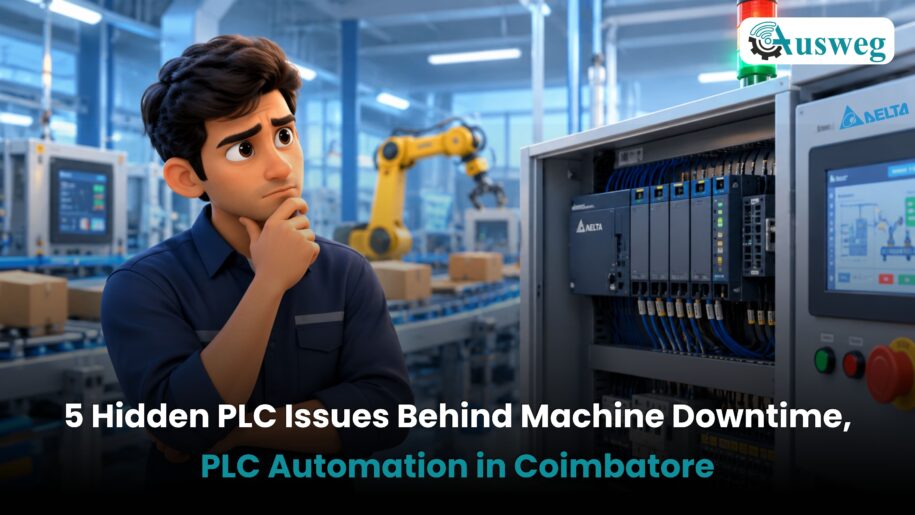
Why Is Your PLC Failing During Production?
5 common causes behind machine downtime — and why the fault on screen is rarely the whole story.
PLC Automation Solutions in Coimbatore can help manufacturers build reliable control systems for machines and production lines.
Your machine stops. The PLC shows a fault. You restart it. Production starts again. Then the same problem returns.
Before replacing the PLC, there is one question worth asking: is the PLC actually the cause, or is the machine demanding more from its control system than it can reliably handle?
In an automated production line, the PLC is connected to everything that keeps the machine moving — sensors, VFDs, servo drives, HMIs, remote I/O and communication networks. So when production stops, the visible PLC fault may only be the result of a problem elsewhere in the control system.
Here are five common situations where the real problem may be deeper than the PLC fault displayed on the screen.

1Does the machine stop when a VFD or motor starts?
The machine is running normally.
A motor starts. The VFD switches. The PLC resets.
The sequence stops. Production waits.
If this happens repeatedly, replacing the PLC immediately may not address the issue. Motor switching, control-supply disturbances, grounding problems, electrical noise and poor separation between power and control wiring can all affect the stability of an automation system.
What should the solution look at?
Instead of treating the PLC as an isolated component, the PLC, VFD, power supply, control panel and grounding arrangement need to work as one control architecture. This is where selecting the right PLC platform and integrating it correctly with the drive system becomes important.
For machine builders and manufacturers in Coimbatore, Delta PLC solutions can provide a control platform for applications involving PLCs, VFDs, HMIs and other automation devices. The appropriate Delta PLC depends on factors such as I/O requirements, communication, and machine complexity.
At Ausweg, the focus is on matching the PLC and automation components to the machine requirement — rather than treating every production stop as a PLC replacement problem.
2Is the PLC in RUN mode while the machine is still stopped?
This situation can be frustrating because everything may look normal from the PLC side.
The CPU is in RUN. The machine isn’t moving. Why?
Because the PLC may simply be waiting for an input condition. For example, a cylinder is supposed to extend — the sequence will continue only after the proximity sensor confirms the position. If that signal never reaches the PLC, the controller may correctly hold the sequence.
The actual issue could be:
- Sensor not detecting the target
- Incorrect sensor positioning
- Damaged field wiring
- Missing PLC input
- An interlock condition
- Sequence logic waiting for another device
Where does the solution begin?
The key is to connect the machine requirement with the PLC’s I/O architecture. If a machine has been expanded with sensors, actuators or stations, the controller must have the appropriate I/O capacity and communication capability to handle those requirements reliably.
Delta PLC platforms offer options for machine applications, allowing the control system to be selected around the required I/O, expansion and communication architecture. For a manufacturer upgrading a machine in Coimbatore, Ausweg can help identify the Delta PLC and associated automation components based on what the machine actually needs.
That means the solution starts with the machine requirement — not with a random PLC replacement.
3Does restarting the PLC fix the problem — temporarily?
A restart can bring the machine back to life. But if the same fault appears again after a few production cycles, the restart has solved only the immediate symptom.
Random alarms → machine stop → PLC restart → production resumes → same fault returns.
That recurring sequence can point toward issues involving:
- Input/output signals
- Communication interruptions
- Drive-related faults
- Sequence conditions
- Field devices
- Controller capacity or configuration
- Power-related disturbances
What changes when the right PLC solution is selected?
A reliable automation architecture should make it easier to monitor machine conditions, manage I/O, communicate with devices and handle the required control sequence. Simply replacing a PLC with another controller of similar capacity may not address new requirements.
A suitable Delta PLC can be selected based on the machine’s application, including I/O count, processing requirements, communication requirements and future expansion. This is where Ausweg’s industrial automation solutions in Coimbatore bring the PLC selection in line with the machine requirement.
The objective isn’t simply “how do we restart the PLC?” It is: what control architecture will help this machine run reliably?
4Is communication between the PLC and other devices breaking down?
Today’s production machines rarely operate with a PLC alone. A typical control system may involve:
PLC → HMI → VFD → Servo Drive → Remote I/O → Sensors
When communication between any of these devices becomes unstable, the machine sequence can stop even though the PLC CPU itself is still running. This can create a confusing situation: the PLC is on, the HMI is on, the drive is on — but the machine isn’t producing.
Communication parameters, network configuration, cabling, device compatibility and controller capability all become relevant.
The solution: build the PLC around the communication requirement
This is one reason PLC selection should happen after understanding the machine architecture, rather than choosing a controller based only on CPU specifications.
Delta’s PLC range includes platforms such as DVP, AS, AH and AX-5, allowing different machine requirements to be addressed across PLC control, communication-intensive automation and motion applications. A simple machine expansion may need I/O and communication, while a more advanced application may require coordinated motion and higher control performance.
Ausweg works with Delta PLC solutions as part of industrial automation applications, helping manufacturers choose the controller and connected automation components around the actual production requirement — making PLC selection part of the machine’s long-term automation architecture, rather than just a replacement purchase.
5Has your machine changed — but your PLC hasn’t?
This is one of the most overlooked causes of automation problems.
Started with: PLC + HMI + sensors
Became: PLC + HMI + VFDs + servo axes + additional sensors + remote I/O + networked devices
The machine has evolved. The original control architecture may not have evolved with it. That can create limitations in:
- I/O capacity
- Processing requirements
- Communication
- Motion control
- Expansion
- Machine sequence management
At this point, replacing the existing PLC with another controller of basic specification may simply move the problem forward.
A better approach: size the PLC around the machine’s requirement
Delta provides PLC platforms suited to different levels of industrial automation — from DVP controllers for machine applications to AS, AH and AX-5 platforms for more advanced control and motion requirements. The right choice depends on the application: I/O count, processing demand, communication architecture, motion requirements and planned expansion.
For manufacturers in Coimbatore and across Tamil Nadu, Ausweg provide Delta PLC-based automation solutions aligned with these machine requirements, along with HMI, VFD, servo and control-panel integration. A machine upgrade shouldn’t mean putting a newer PLC into an old architecture — the control system should be ready for what the machine needs.
Why choose the right PLC solution instead of just replacing the PLC?
A production stop can make the PLC look like the problem. The real requirement may be different. You may need more I/O, better communication, faster processing, motion control, drive integration, machine expansion — or simply a PLC that fits the application properly.
That is why PLC selection should be driven by the machine, the process and the future automation requirement.
At Ausweg Info Controls, Delta PLC solutions are part of an industrial automation portfolio covering PLC, HMI, VFD, servo, control panels and machine automation. Whether it’s a new machine, an existing machine upgrade or an automation expansion, the PLC can be selected around the required control architecture and application requirements.
For manufacturers looking for Delta PLC and industrial automation solutions in Coimbatore, the focus is not on selling a controller in isolation — it’s on finding the right combination of automation products for the machine.
For manufacturers looking for PLC Automation Solutions in Coimbatore, understanding the actual cause of recurring machine downtime is important before replacing the PLC.
That means the solution starts with the machine requirement — not with a random PLC replacement.
Is your PLC really the problem?
If you are planning a PLC replacement, machine automation upgrade or PLC Automation Solutions in Coimbatore, talk to Ausweg Info Controls to identify the right control architecture for your machine.
The better question is: does your current PLC architecture still match your machine?
Talk to Ausweg Info Controls
Leave a Reply