
7 automation trends before your next investment
Manufacturing automation is no longer about simply installing a robot, PLC, or production monitoring system and expecting efficiency to improve. The latest automation trends are changing how manufacturers approach connectivity, flexibility, intelligence, and long-term production performance.
1. Automation Trends Are Moving From “Machine-Level” to “Process-Level” Intelligence
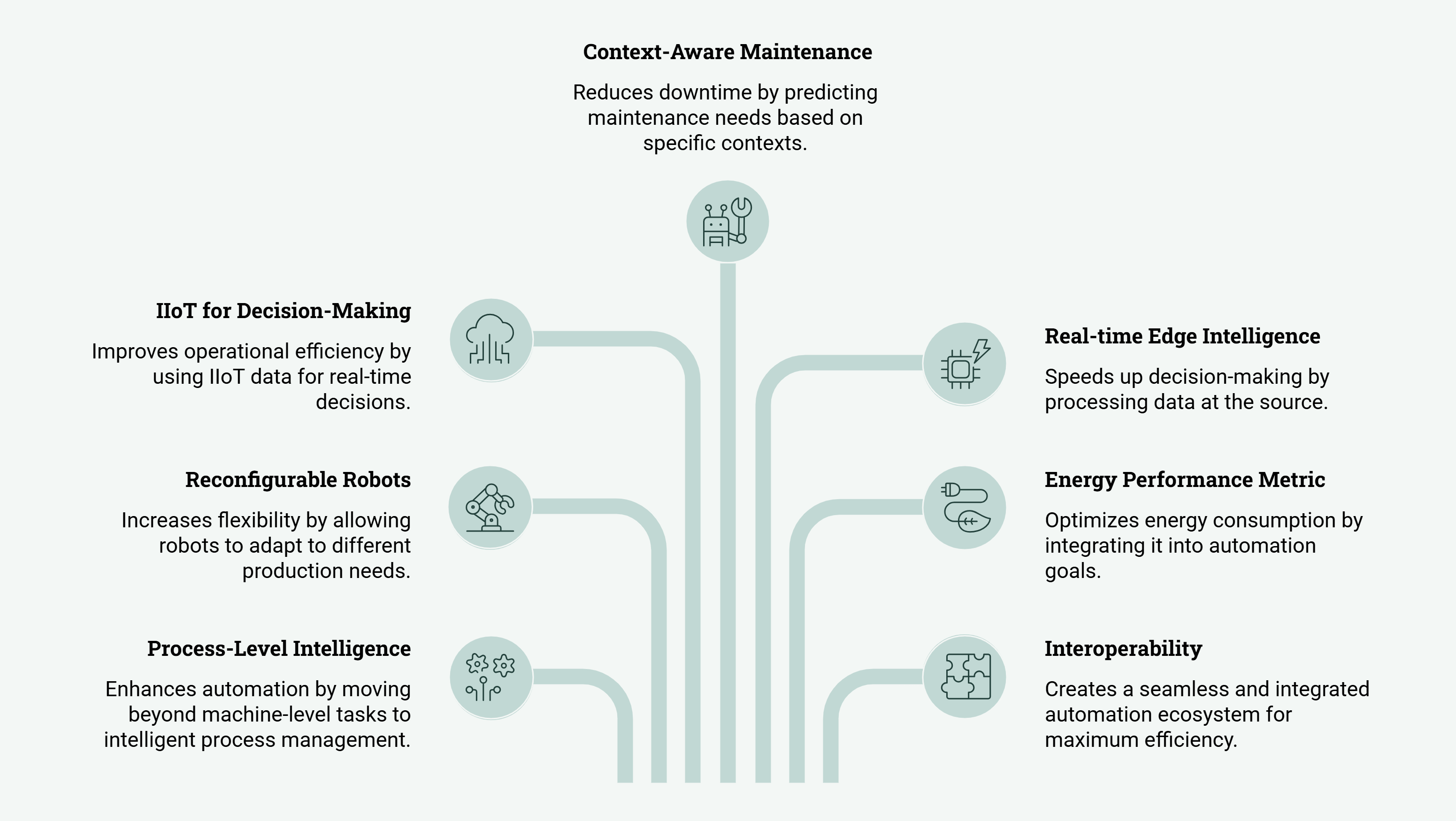
Traditional automation focuses on individual machines — a PLC controls it, an HMI displays its status, sensors report on it. The next stage connects multiple machines and their data, so a small variation in one stage can be traced before it causes downtime or quality issues further down the line.
This is where Industrial Automation meets IIoT. The question shifts from “Is this machine running?” to “Is the entire process performing as expected?”
Robots are becoming reconfigurable production assets
Robotics is moving past the idea of one robot for one fixed task, left untouched for years. With product variants and batch sizes changing quickly, a robotic system that can be redeployed — for pick-and-place, machine tending, assembly, palletizing, inspection, or material handling — becomes far more valuable.
Payload and reach still matter, but ease of integration, programming flexibility, and adaptability now shape long-term value just as much.
Automation Trends Are Turning IIoT Data Into Operational Decisions
IIoT has long meant dashboards, sensors, and machine data — but collecting data was never the real objective. The value shows up when that data helps someone make a better operational decision: spotting recurring downtime, comparing machine performance, tracking OEE, or catching unusual patterns early.
That turns IIoT from “what happened?” into “what should we do next?”
Predictive maintenance will become more context-aware
A temperature rise, vibration change, or current variation doesn’t always mean the same thing — its significance depends on load, operating conditions, cycle, and history. Context-aware systems combine these signals into a fuller picture of machine health, helping teams tell a normal variation apart from a condition that truly needs attention.
That’s a shift from reacting to failures toward understanding why behaviour is changing in the first place.
Real-time edge intelligence will push decisions closer to the machine
Not every industrial decision can wait for data to travel to a server and return with an instruction. Edge intelligence brings processing closer to machines, controllers, sensors, and cameras — supporting faster responses for machine vision, motion control, robotics, and real-time process control.
The advantage isn’t just speed; keeping processing close to the source also cuts unnecessary data movement.
Energy performance is becoming an automation metric
Performance can no longer be measured through output, cycle time, and utilization alone. A machine may hit its output target while consuming far more energy than necessary — still leaving an improvement opportunity on the table. Combining energy monitoring with production data reveals consumption patterns across machines, shifts, and conditions.
Energy stops being a separate activity and becomes part of the same performance conversation as production.
Why Interoperability Is One of the Most Important Automation Trends
The most important question before an investment isn’t “what does this system do?” — it’s “how well will it work with everything else we already have?” Most plants run equipment from many providers: PLCs, HMIs, robots, drives, sensors, SCADA, MES, and legacy machines that all need to coexist.
When these systems stay isolated, valuable information stays trapped inside them. Interoperability lets it move.
Built for what comes next
Machine-level intelligence is becoming process-level intelligence. Robots are becoming more adaptable. IIoT is turning data into decisions. Maintenance is becoming contextual. Edge computing is moving closer to operations. Energy has entered the performance equation. And interoperability is becoming the backbone of every scalable automation ecosystem.
The future of automation isn’t about automating more machines — it’s about building an operation that’s smarter, more connected, and more adaptable.
Leave a Reply