Cobots vs Industrial Robots
Today’s assembly lines are changing with automation. Robots can take over repetitive tasks such as picking and placing components, assembling, inspecting and handling materials — helping to improve consistency in production.
Cobots vs Industrial Robots is an important consideration when choosing automation for your assembly line.. However, they are used for different production requirements. The best one for you will depend on your production volume, cycle time, payload, flexibility, workspace, safety requirements and future automation plans. So, let’s get into it.
The Two Options
What is a Cobot
A Cobot, or Collaborative Robot, is built for applications where people and robots can work closely together — subject to the required safety assessment and safeguards. Cobots are often chosen when manufacturers need a flexible automation solution that adapts easily to changing production requirements.
What is an Industrial Robot?
Industrial Robots are the priority where speed, repeatability, payload and continuous operation are essential in demanding production environments. If your process needs to run continuously at high speed with consistent output, an Industrial Robot may be the better fit.
Cobots vs Industrial Robot – What’s the Difference?
It’s not about which is the better technology — it’s about which one is more suitable for your production process.
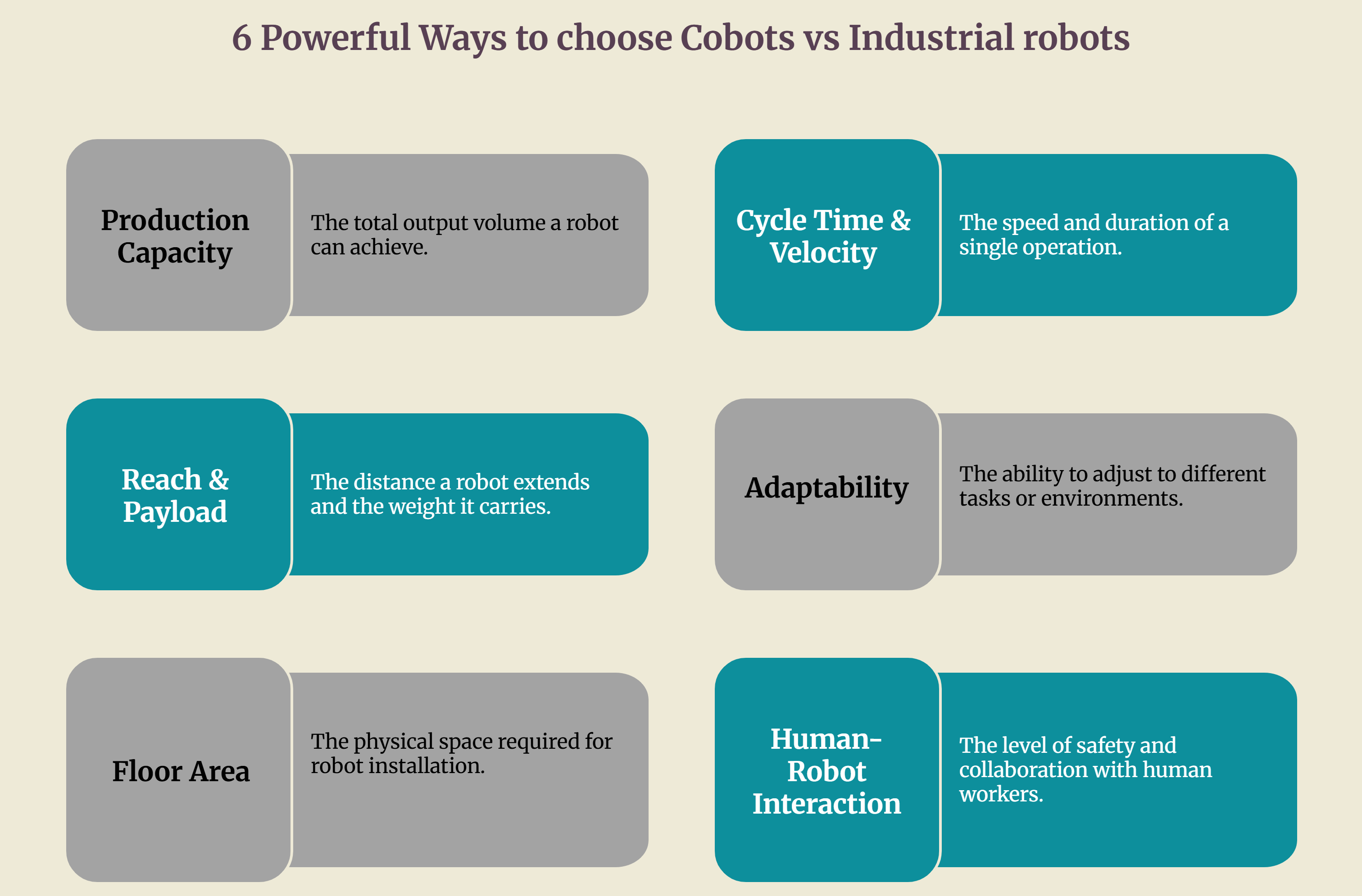
Production Capacity
Are you producing a lot of the same thing every day? An Industrial Robot might be a better fit for high-demand, continuous repetitive operation. If your production involves small batches or frequent product variations, a Cobot may provide the flexibility you need.
Cycle Time & Velocity
Every second you save is an increase in output. Industrial Robots are typically designed for high-speed applications where fast cycle times matter. Cobots are chosen more for flexibility and operator interaction than for the fastest possible cycle time. Ask yourself: how quickly does this process really have to be?
Reach & Payload
Consider the gripper, tooling, cables and workpiece when calculating total payload. An Industrial Robot may be the better option for heavier components or larger tooling, while Cobots suit lighter assembly and handling applications.
Adaptability
If your line works with different products or frequent changeovers, flexibility is essential. A Cobot can potentially be re-used across tasks — pick & place today, assembly tomorrow, machine tending the next batch. Industrial Robots can be flexible too, but are often part of dedicated automation cells built for specific requirements.
Floor Area
Factory floor space is at a premium. Cobots tend to have a smaller footprint and can integrate into existing workstations. Industrial Robots may need a dedicated cell with additional equipment and safeguarding.
Human-Robot Interaction
This is one of the biggest differences. Cobots are intended for applications where human interaction may occur in the workflow — but that doesn’t mean no safety measures are required. Every application needs a proper risk assessment based on robot speed, tooling, workpiece and operating conditions. Industrial robots are usually installed in dedicated cells with appropriate protection.
Ready to explore automation for your assembly line?
Find the right robotic solution for your application.
Visit Us!Cobots vs Industrial Robots – Which Is Right for Your Assembly Line?
A Cobot may fit when you need
- Flexible automation
- Frequent product changeovers
- Compact installation
- Lighter payload handling
- Human interaction within the process
- Easy adaptation to changing tasks
An Industrial Robot may fit when you need
- High-speed operation
- High production volume
- Higher payload capacity
- Fast cycle times
- Continuous operation
- Maximum production throughput
What If You Need Both?
Today’s assembly lines don’t have to settle for one. A hybrid automation approach combines Cobots and Industrial Robots according to the need of each process — an industrial robot handling repetitive high-speed operations while a cobot assists with flexible assembly or inspection.
Don’t Choose the Robot. Choose the Right Application.
One of the biggest mistakes manufacturers make is selecting a robot based only on price, payload or popularity. The better approach is to start with the application.
Why Ausweg?
The right choice between Cobots vs Industrial Robots depends on your application, production goals, and automation requirements.
At Ausweg Info Controls, we look beyond the robot itself. Our approach focuses on understanding your application first — including production requirements, process challenges, cycle time, payload, workspace and future automation goals. As an Authorized Distributor of DOBOT in India and a KUKA System Integrator, we bring expertise across Industrial Automation, Robotics, IIoT, SkillForge to help manufacturers identify where automation can create measurable value and then build solutions around those requirements.
From robot selection and application engineering to integration and automation support, our focus is on making automation practical, scalable and production-ready. Because the right automation isn’t simply about having a robot on the factory floor — it’s about having the right robot, performing the right task, in the right way.
Ready to explore automation for your assembly line?
Talk to Ausweg Info Controls and find the right robotic solution for your application.
Talk to Ausweg Info Controls
Leave a Reply