

Condition-Based Monitoring vs Predictive Maintenance – What Should Manufacturers Actually Implement?
Condition-Based Monitoring helps manufacturers detect changes in machine health before they become costly failures.
A machine rarely fails without giving a warning. The problem is that most plants aren’t capturing that warning early enough.
A bearing may start vibrating differently. A motor may begin drawing more energy than usual. A temperature may gradually drift away from its normal operating range. None of these changes necessarily stop production immediately.
But they can be the beginning of a failure.
The machine is still running, so nobody acts. By the time it stops, maintenance becomes an emergency.
That is where Condition-Based Monitoring, or CBM, becomes important.
A machine can be running and still be getting worse
Traditional maintenance usually follows one of two approaches.
Wait until the machine fails, then repair it.
Service the machine on a fixed schedule, whether its actual condition needs it or not.
Both approaches share the same limitation- neither is continuously connected to the machine’s actual condition.
A machine does not deteriorate according to the calendar. Two identical motors operating under different environments, loads, speeds and duty cycles can age at completely different rates.
This is why maintenance teams need to ask a different question.
What is the machine telling us right now?
That is the purpose of Condition-Based Monitoring.
What is Condition-Based Monitoring?
Condition-Based Monitoring continuously observes the health of equipment using machine-condition data. Instead of waiting for a breakdown, or relying only on a maintenance calendar, CBM builds visibility into how equipment is actually behaving during operation.
Data from multiple sensors and sources is collected and monitored to identify abnormal conditions. The system then triggers alerts when defined conditions or thresholds are crossed.
For example, instead of discovering a problem during the next scheduled inspection, the maintenance team is alerted the moment the machine’s condition starts moving outside its expected range.
CBM changes maintenance from check the machine periodically to watch the machine continuously.
That distinction is more important than it sounds.
Then where does Predictive Maintenance come in?
Predictive Maintenance, or PdM, takes the next step. CBM tells you what is happening to the machine’s condition. Predictive Maintenance uses historical and real-time data, analytics and AI-driven insight to identify patterns that can indicate a potential future failure. Learn more about predictive maintenance from IBM
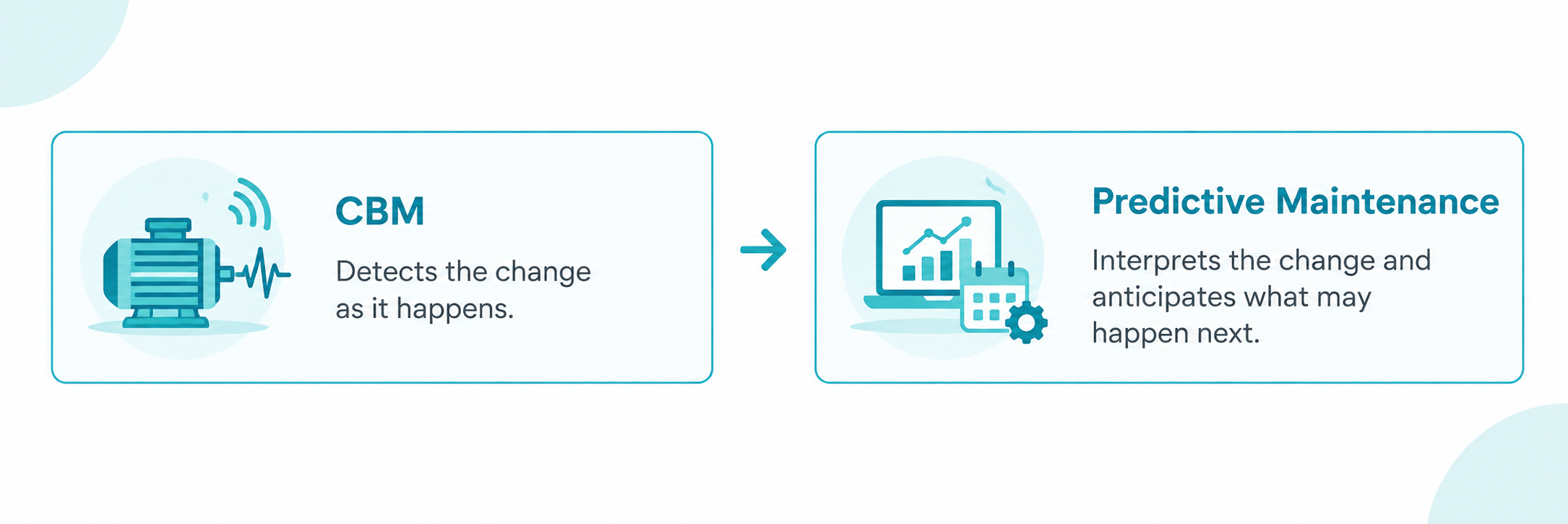
So CBM and PdM are not competing strategies. In a connected maintenance architecture, CBM provides the condition visibility that makes predictive analysis meaningful. Without reliable condition data, prediction becomes much harder.
The practical difference
Put side by side, the two approaches answer different questions.
| Condition-Based Monitoring | Predictive Maintenance |
|---|---|
| Focuses on current machine condition | Focuses on potential future failure |
| Continuously monitors equipment parameters | Analyses patterns and trends to predict failure |
| Uses alerts when conditions cross defined limits | Uses analytics and AI to identify failure tendencies |
| Helps teams respond to abnormal conditions | Helps teams plan maintenance before failure |
| Answers: Is something changing? | Answers: What could happen next? |
The important point is this: prediction should not be the starting point. Data quality and condition visibility should be.
How Ausweg approaches CBM
Ausweg’s Predicta (CBM) Condition-Based Monitoring solution combines real-time condition monitoring with predictive analytics, rather than treating them as two disconnected systems.
Predicta (CBM)
The solution collects data from multiple sensors and sources, provides customizable condition alerts, and makes equipment information accessible through a secure cloud-based platform. It also delivers automated reports, supports integration with existing infrastructure, and includes energy-efficiency monitoring.
A more practical maintenance workflow
The objective is not simply to put another dashboard in front of the maintenance team. The objective is to give the team enough visibility to make a better decision before a condition becomes a breakdown.
Why this matters on the shop floor
Consider a production machine that has been operating normally for months. If its condition begins changing today, a calendar-based maintenance plan may not react until the next scheduled service. A CBM system can identify the change while the machine is still operating. Predictive analytics can then help determine whether that change represents a developing failure pattern.
This gives maintenance teams something far more valuable than a failure notification – time to respond.
- Time to inspect
- Time to plan a shutdown
- Time to arrange spares
- Time to schedule technicians
And most importantly, time to make the decision before the machine makes it for you.
The better question for manufacturers
The question is no longer simply should we use CBM or Predictive Maintenance?
A better question is:
Do we have continuous visibility into machine condition, and can we turn that data into an actionable maintenance decision?
CBM creates the visibility. Predictive Maintenance adds intelligence to that visibility. And when both are connected through an IIoT-based system, maintenance can move from breakdown response to condition-driven decision-making.
That is where smarter maintenance begins.
Leave a Reply