
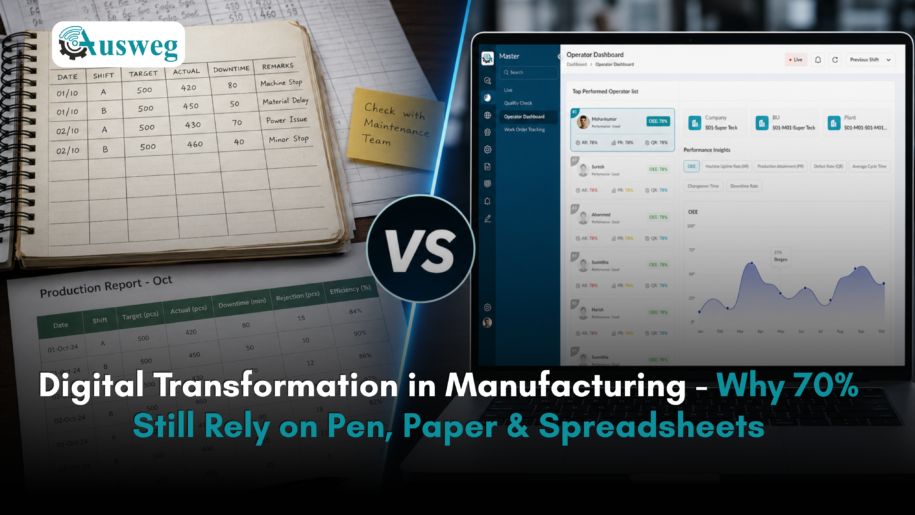
Why 70% of Manufacturers Still Run on Pen, Paper & Spreadsheets
Manufacturing has become more connected and automated. Yet inside many factories, critical production information is still written in notebooks, maintained in Excel sheets, or collected manually from machines.
When information is disconnected, decision-making becomes slower.
When data is scattered across systems, identifying problems takes longer.
When real-time visibility is missing, teams react instead of acting proactively.
The Real Cost of Manual Manufacturing Data
Consider a production floor where an operator records machine downtime in a register. At the end of the shift, a supervisor transfers the information into a spreadsheet.
The maintenance team has a separate breakdown log. Energy consumption may be monitored independently, while production performance is reviewed in another report.
Every team has data, but nobody has the complete picture.
Where Production Visibility Breaks Down:
The result is more than paperwork: slower decisions, delayed action, limited visibility, and missed productivity opportunities.
What Digital Transformation Should Actually Solve
Digital transformation is not about adding technology for the sake of technology.
It is about making the right information available to the right people, exactly when they need it—so they can understand what’s happening, respond faster, and make better decisions.
When a machine stops, the production team should know why it stopped, how long it remained down, and what action is required. Maintenance teams should identify repeated equipment issues before major disruptions, while energy data should be connected to production activity.
This is where connected manufacturing intelligence matters.
From Manual Tracking to Measurable Performance with Efficio OEE
OEE is often discussed as a manufacturing KPI. But its real value comes from making production performance visible and actionable.
Ausweg’s Efficio OEE helps manufacturers move beyond manually maintained production records by bringing machine and production performance into a structured digital view.
Teams can work with visibility into Availability, Performance, and Quality instead of asking “Why did production fall today?” after the shift.
Real-time production insights help teams identify performance gaps before they become bigger problems.
With clear visibility into machine performance, teams can focus on improving productivity instead of collecting data manually.
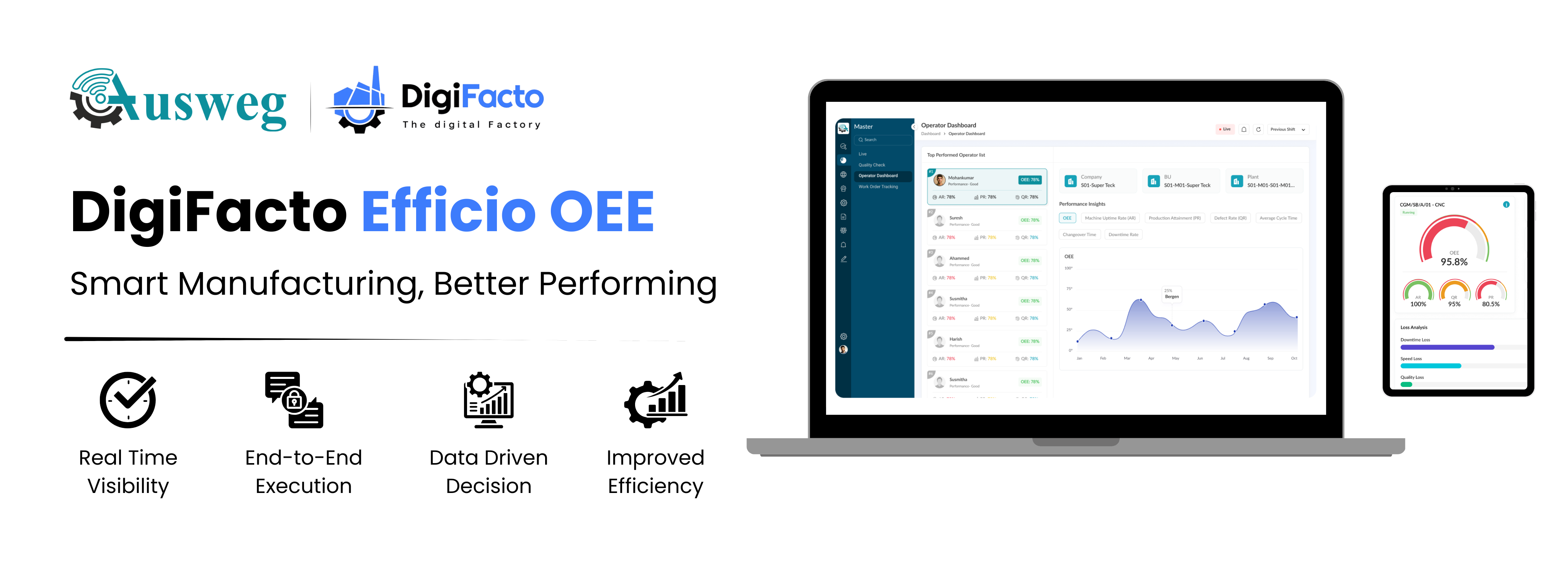
Efficio OEE helps answer practical shop-floor questions:
- Which machines are losing productive time?
- Where is unplanned downtime occurring?
- Are machines running at expected performance?
- Where are production losses repeating?
- Is actual output aligned with production targets?
This turns OEE into a practical tool for everyday decisions, helping teams act on real production insights rather than simply tracking numbers in a report.
WhyAusweg
Ausweg’s DigiFacto Efficio OEE helps manufacturers move beyond manual registers and spreadsheets to gain clear visibility into Availability, Performance, and Quality.
With Efficio OEE, teams can understand:
- Which machines are losing productive time?
- Where is downtime occurring?
- Are machines running at their expected performance?
- Is actual production aligned with the target?
Instead of just looking at an OEE number, manufacturers can see where production is being lost. This helps teams identify the root causes, prioritize what needs attention, and take action to improve overall productivity.
Leave a Reply