
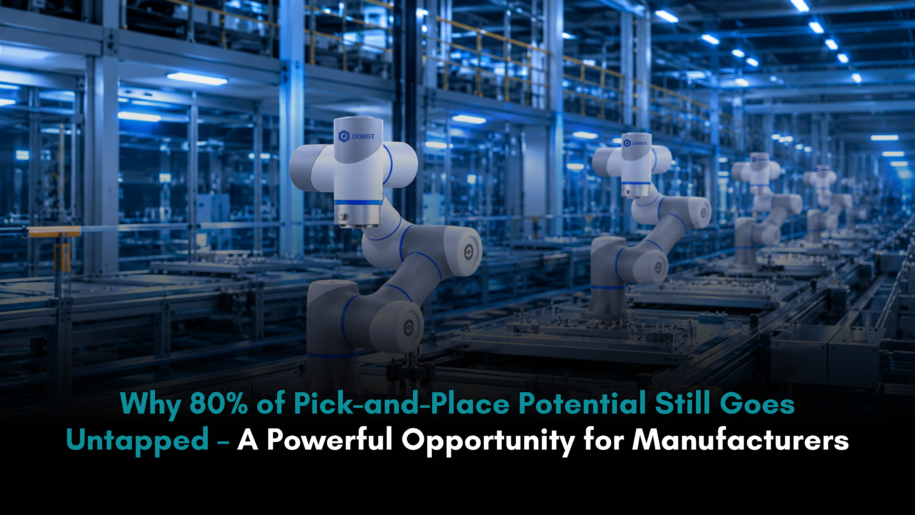
Pick-and-Place Automation Unlocks a Powerful Opportunity in Manufacturing
Pick-and-Place Automation Could Be the Key to Unlocking Productivity Gains
What if the key to improving productivity isn’t adding new equipment, but optimizing a process already part of your daily operations?
Pick-and-place automation plays a critical role across the production floor, with thousands of repetitive movements happening every day. Yet, the true potential of pick-and-place automation is often underestimated. Hidden inefficiencies in these routine handling tasks can quietly affect output, consistency, and overall workflow performance in pick-and-place automation systems.
Could this be where your untapped potential in pick-and-place automation is hiding?
The opportunity hidden in plain sight
Pick-and-place isn’t a background task. It’s a lever.
Manufacturers invest heavily in faster machines, advanced production systems, and quality improvements. Yet one area often receives far less attention than it deserves: pick-and-place operations — from moving components to transferring finished products, these repetitive tasks happen thousands of times every day.
At first glance, they may seem like routine activities that simply keep production moving. However, the efficiency of these tasks has a direct impact on productivity, workflow continuity, and overall operational performance. And this is where a significant amount of untapped potential often exists.
STEP 01
The Hidden Cost of Repetitive Movement in Pick-and-Place Automation
In many manufacturing environments, products rarely move through the production process on their own. They are constantly being picked, positioned, loaded, unloaded, sorted, transferred, and packaged. Each movement may take only a few seconds — but when these actions are repeated hundreds or thousands of times throughout a shift, even the smallest inefficiencies accumulate into significant productivity losses. The challenge is that these losses are often hidden within daily operations. They don’t always appear as major disruptions. Instead, they quietly affect workflow efficiency, cycle times, and production output.
Actual results may vary, but even small productivity improvements can lead to substantial output gains over time.
STEP 02
Why productivity gaps are hard to spot
Most manufacturers closely monitor machine performance — downtime, output, and quality metrics are regularly tracked and analyzed. However, inefficiencies in pick-and-place operations are often more difficult to identify. Unlike machine failures, they rarely stop production completely. Instead, they show up as small delays, inconsistent handling times, waiting periods, and workflow interruptions. Because these issues occur gradually, they are often accepted as part of the process rather than recognized as opportunities for improvement. As a result, a considerable amount of productivity potential remains hidden.
Small delays between processes
Gaps that add up silently across every shift.
Inconsistent handling times
Cycle times that drift depending on who — or what — is doing the move.
Waiting during material transfer
Parts and product sitting idle between stations.
Interruptions during changeovers
Small breaks in flow that ripple downstream.
STEP 03
The opportunity most manufacturers overlook
When manufacturers think about improving efficiency, the focus is often placed on machines, equipment upgrades, or production speed. While these areas are important, they are only part of the equation. The real opportunity often lies in improving the flow of products between processes — and in many cases, optimizing product movement can unlock improvements that traditional equipment upgrades alone cannot achieve.
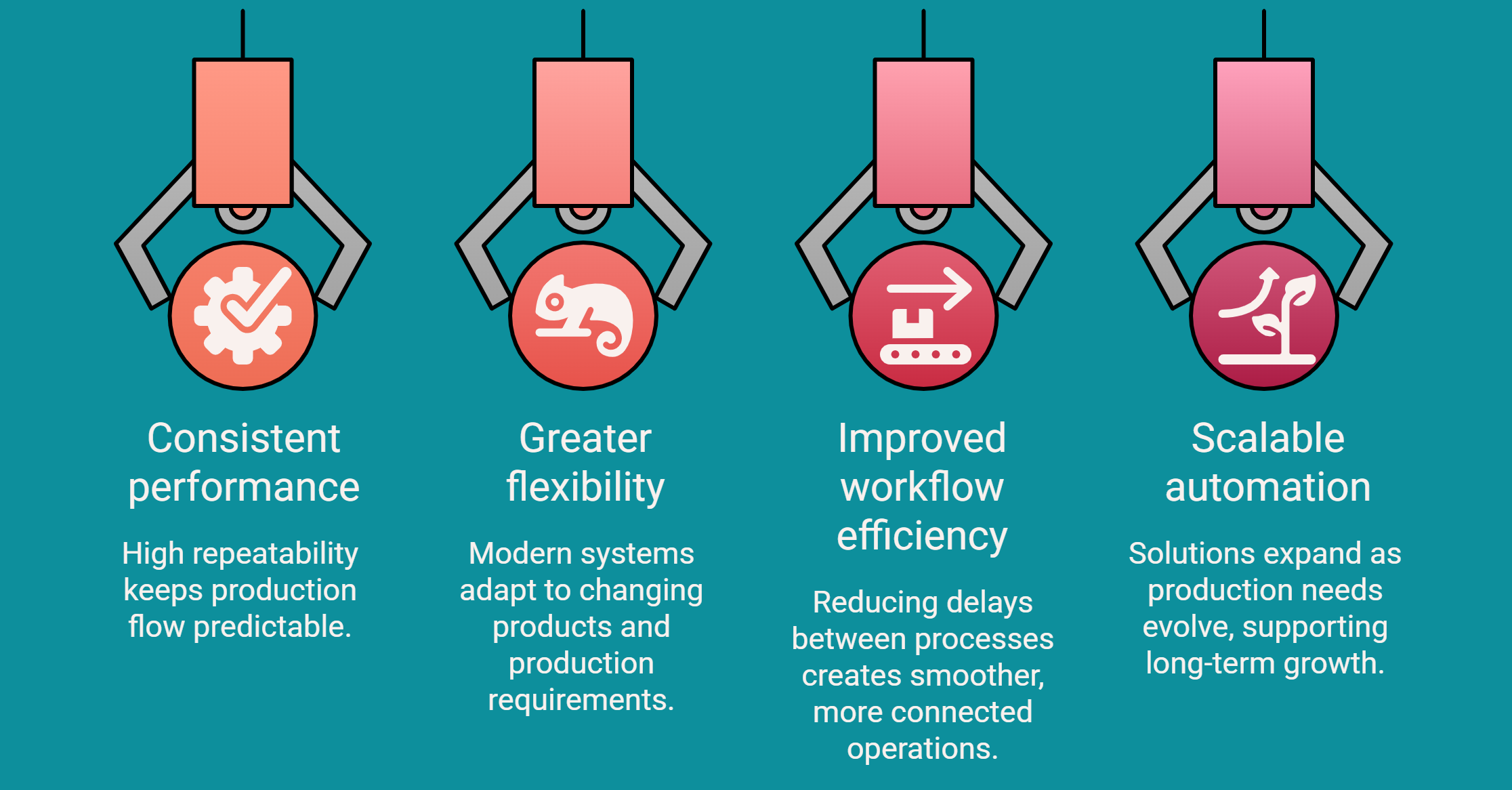
Improved consistency
Predictable handling, every single cycle.
Reduced waiting time
Less idle time between production steps.
Better workflow coordination
Stations that hand off cleanly every time.
Higher throughput
More good parts out, same footprint.
Greater production flexibility
Room to flex and adapt with demand.
STEP 04
A smarter approach to pick-and-place operations
Modern manufacturing is becoming increasingly complex. Manufacturers are expected to handle more product variants, smaller batch sizes, faster delivery expectations, and frequent production changes. As these demands increase, traditional handling methods often struggle to keep pace. Rather than focusing solely on production equipment, they are looking at how products move throughout the entire process — with one clear goal: create a faster, more efficient, and more adaptable production flow.
More complexity per line
More product variants, smaller batch sizes, faster delivery expectations, and frequent changeovers — all on the same equipment.
Focused only on machines
Upgrades to equipment speed, quality control, and throughput — but the movement between stages gets ignored, leaving 80% of gains on the table.
Rethink how products move
By optimizing material flow and pick-and-place operations, manufacturers unlock improvements that equipment upgrades alone cannot deliver.
Faster. More efficient. Adaptable.
A production flow that responds to demand, reduces waste, and scales without disruption.
STEP 05
How robotics helps unlock hidden potential
This is where robotics is transforming pick-and-place operations. Modern robotic systems help manufacturers improve repetitive handling activities with greater consistency and precision. Instead of redesigning entire production lines, robotics can enhance the specific processes that have the greatest impact on productivity — creating a more efficient and responsive manufacturing environment.
STEP 06
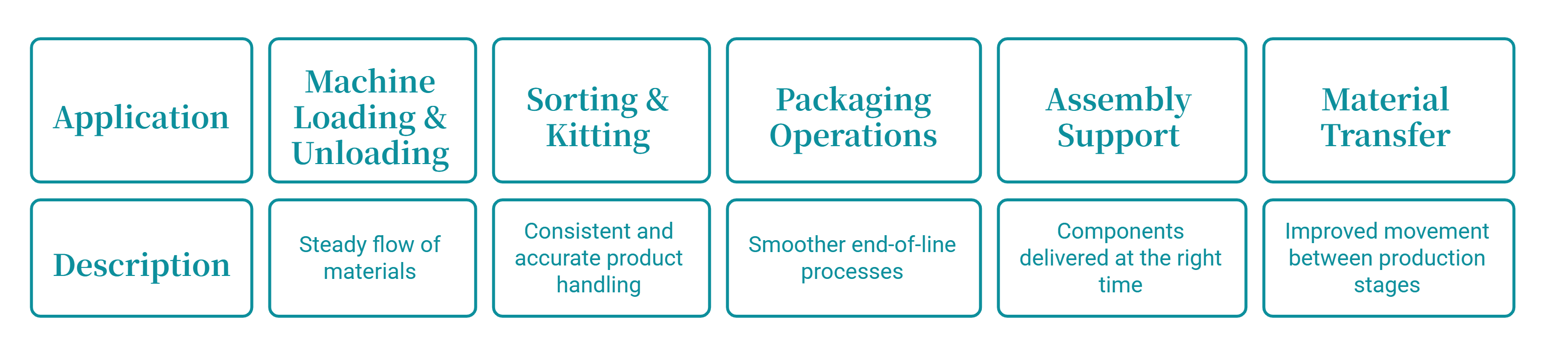
Areas where improvement happens fastest
While pick-and-place opportunities exist throughout manufacturing, some applications consistently deliver immediate benefits — and are often where hidden productivity gains become visible first.
Identify
Spot the gaps
Analyze
Map the flow
Automate
Deploy robotics
Optimize
Tune & improve
Scale
Grow confidently
STOP 07
Is your factory missing the opportunity?
Not all productivity losses are easy to identify. The following questions can help reveal whether untapped potential exists within your current operation. If the answer is yes to any of these, there may be significant opportunities hidden within your pick-and-place workflow.
- Are products frequently waiting between processes?
- Do repetitive handling activities consume valuable production time?
- Are bottlenecks affecting overall throughput?
- Do product variations create operational challenges?
- Are you looking for ways to improve efficiency without major infrastructure changes?
Turning hidden potential into measurable results
The greatest opportunities in manufacturing aren’t always found through major investments or large-scale process changes. Sometimes they’re hidden within the repetitive activities that happen every day.
By rethinking pick-and-place operations and improving how products move throughout the production process, manufacturers can unlock greater efficiency, consistency, and productivity.
At Ausweg Info Controls, we help manufacturers identify opportunities to improve material flow, optimize pick-and-place operations, and implement intelligent automation solutions that support long-term productivity growth.
Connect with our automation experts
Leave a Reply