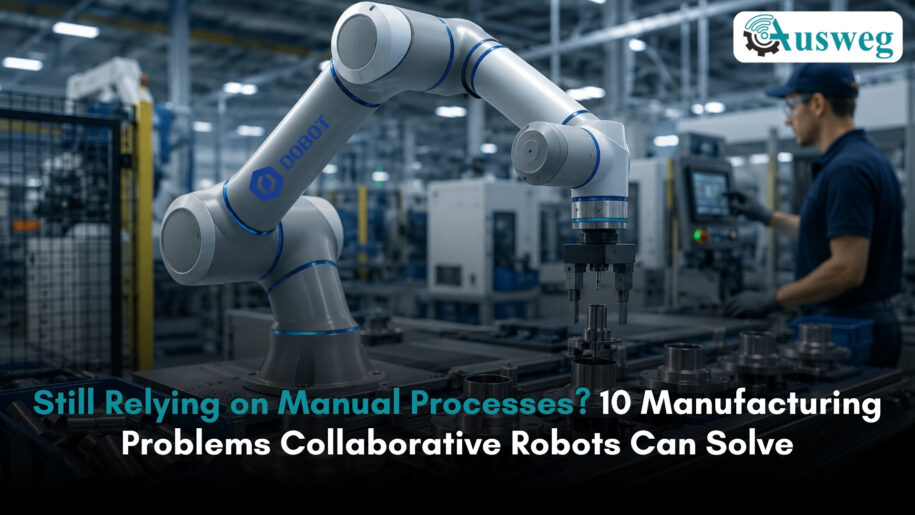
10 Manufacturing Challenges Collabrative Robots (Cobot) Can Solve
Automation does not always mean replacing an entire production line — sometimes it means fixing the one repetitive task that is quietly limiting your output.
In many factories, the biggest operational losses happen within small, repetitive processes — loading a CNC machine, welding components, inspecting parts, fastening screws, moving materials, or packing finished products.
Individually, these tasks may appear insignificant. But when they are repeated hundreds or thousands of times across multiple shifts, they can affect machine utilisation, production consistency, quality, operator productivity, and delivery performance.
This is where Collaborative Robots (Cobots) can provide a practical path to automation. Rather than redesigning an entire production system, manufacturers can deploy cobots around specific repetitive applications where there is a measurable operational problem.
10 Manufacturing Problems Cobots Can Help Solve
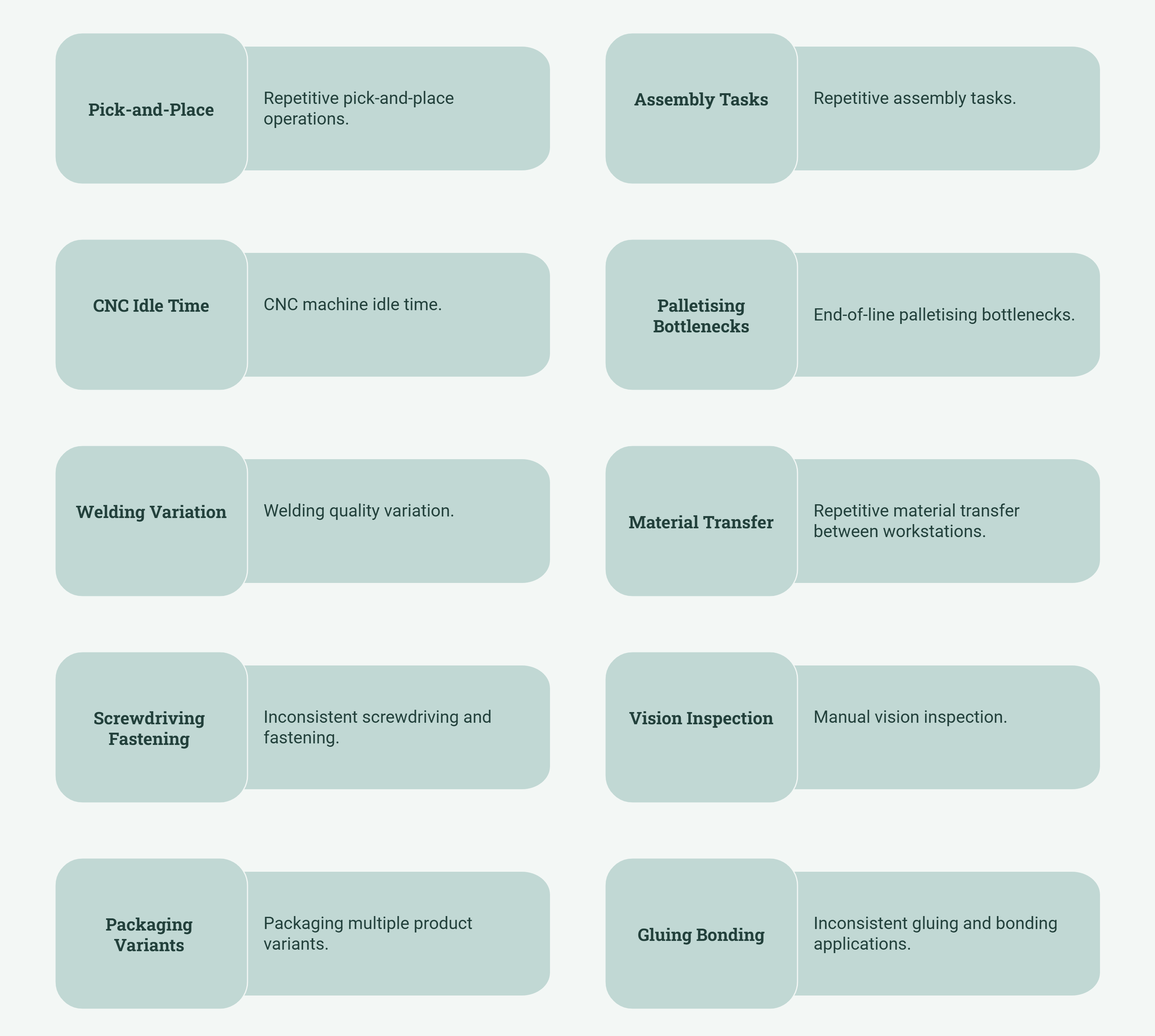
Repetitive Pick-and-Place Operations
With an appropriate gripper, a cobot can repeatedly pick, transfer, and place components according to a programmed sequence.
This makes cobots suitable for component transfer, sorting, feeding, and workstation loading where the movement is predictable.
Repetitive Assembly Tasks
Cobots can be integrated into selected assembly operations such as component insertion, positioning, handling, or part orientation.
Manufacturers do not necessarily need to automate the complete assembly line — they can target the specific assembly step creating the greatest constraint.
CNC Machine Idle Time
A cobot can pick the raw component, load the machine, remove the finished part, and repeat the sequence — best suited for CNC turning, milling, machining centres, and repetitive machine-tending applications.
The objective is not simply to automate part handling. It is to keep the machine productive for a larger portion of the available production time.
End-of-Line Palletising Bottlenecks
A cobot can pick finished products and place them according to a predefined pallet pattern.
This can be particularly valuable for manufacturers looking for flexible palletising automation where product formats or production layouts change frequently.
Welding Quality Variation
A welding cobot can follow a programmed path with controlled movement and positioning for suitable welding applications.
This can create a more repeatable welding process while skilled welders focus on complex jobs that require greater expertise.
Repetitive Material Transfer Between Workstations
A cobot can transfer components between predefined stations, machines, or process points according to a programmed sequence.
This is particularly relevant where the material path is predictable and repetitive, helping create a more structured material-handling process without redesigning the entire production floor.
Inconsistent Screwdriving and Fastening
A cobot integrated with a suitable electric screwdriver can execute fastening sequences at defined positions and parameters.
For repetitive assemblies, this brings greater process control to a critical assembly operation.
Manual Vision Inspection
A cobot can pick and position each part in front of a machine vision inspection system, allowing the camera to check the required points consistently.
This can be used for defect detection, part presence, orientation, measurement, and component verification.
Packaging Multiple Product Variants
Cobots can be programmed for different packaging sequences and paired with suitable end-of-arm tooling.
This flexibility makes them suitable for high-mix production environments where manufacturers need automation that can adapt to changing product requirements.
Inconsistent Gluing and Bonding Applications
A cobot integrated with a suitable dispensing system can follow a predefined path and apply adhesive consistently across the required area.
This makes cobot-based automation useful for repetitive gluing, bonding and dispensing applications where application consistency is important.
Which Process Should You Automate First?
The biggest mistake manufacturers can make is starting with the robot instead of the process. Not every manual operation is a strong candidate for cobot automation. Before investing, manufacturing leaders should evaluate:
- Task repetitions per shift
- Current cycle time
- Machine idle time
- Production volume and takt time
- Quality and rework issues
- Product variation
- Operator time allocated to the task
- Required payload and reach
- Available floor space
- Expected automation uptime
- Integration and maintenance requirements
A task that looks insignificant can become a strong automation opportunity when its cumulative impact is measured. For example, if an operator spends a substantial part of every shift loading and unloading a machine, the question should not simply be “Can a cobot perform this task?”
The better question is: “What happens to machine utilisation, output, quality, and operator allocation if this task is automated?”
That is the level at which a cobot investment should be evaluated.
Cobots Are Not About Automating Everything
The value of collaborative robotics is not in putting a robot into every process. It is about identifying the right repetitive process where automation can solve a measurable manufacturing problem.
For one manufacturer, the opportunity may be CNC machine tending. For another, it may be welding, inspection, palletising, packaging, or material transfer. The right application depends on the process characteristics, production environment, integration requirements, and expected business outcome.
Still relying on manual processes for repetitive production tasks? Identify the bottleneck. Measure its impact. Evaluate the automation opportunity — because the best automation investment is not necessarily the one with the most advanced robot. It is the one that solves the right manufacturing problem.
Why Ausweg?
At Ausweg Info Controls, we start with the manufacturing problem — not the robot. From machine tending and welding to assembly, inspection, gluing, packaging and material handling, we help identify suitable cobot applications based on your process and production requirements. The right process. The right automation. The right outcome.
Have a repetitive process that is limiting your production?
Talk to Ausweg Info Controls
Leave a Reply